
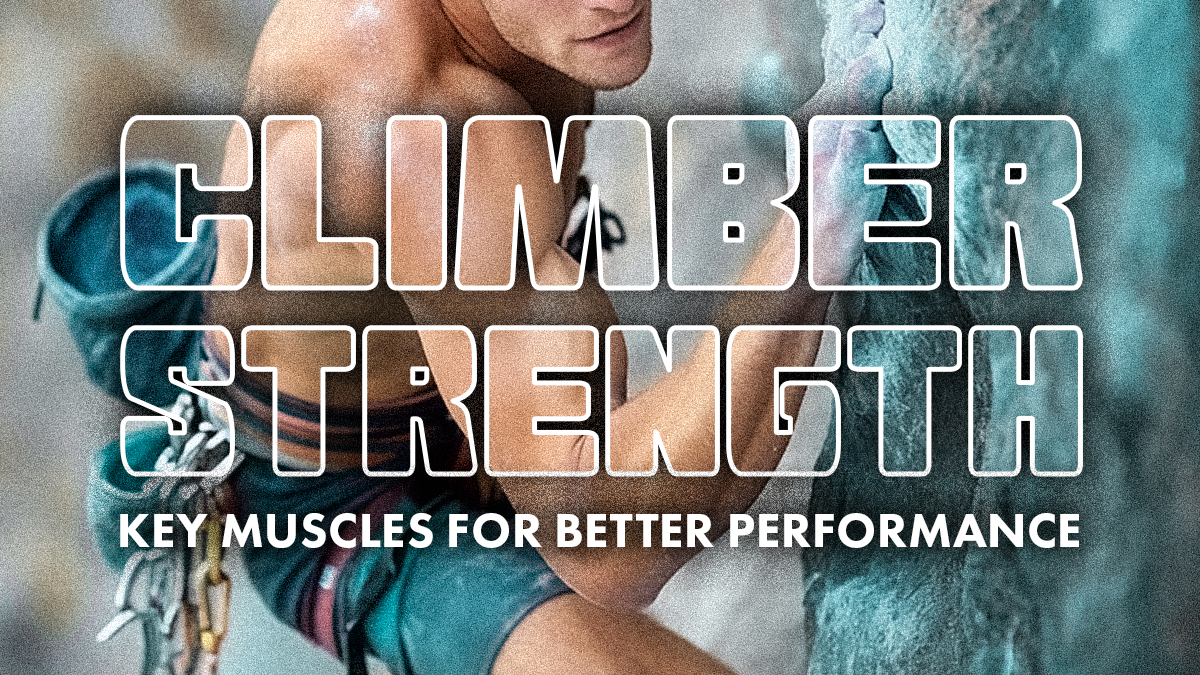
Climbing is a full-body sport, but some muscles do a lot more work than others. Knowing which areas matter most (and how to train them off the wall) helps you climb stronger, move more efficiently, and stay healthier over time.
Below are the key muscle groups climbers rely on, how they show up in common movements, and simple exercises you can add to your training.
Fingers (Pulleys)
Your fingers are your connection to the wall—especially on small crimps and edges. The finger flexors and pulleys in your hands allow you to grip tiny holds and support your full body weight.
How they’re used in climbing
- Crimping and half-crimping small edges
- Hanging from pockets, slopers, and pinches
- Statically holding positions while your feet move
How to train them off the wall
Choose one or two of the following and progress slowly to avoid injury:
- Hangboarding / fingerboarding: Controlled hangs with different grip types (full crimp, half crimp, open hand).
- Campus board (for advanced climbers): Dynamic moves that build finger power and contact strength.
- No-hang finger exercises: Place your fingers on a training edge and gently load them while keeping your feet on the ground to build strength with less risk.
Start with low volume, focus on good form, and stop if you feel sharp pain in your fingers or pulleys.
Shoulders
Climbing heavily recruits the deltoids, trapezius, and rotator cuff—especially on overhanging routes and powerful, dynamic moves. Strong, stable shoulders help you control big reaches and keep your joints supported.
How they’re used in climbing
- Pulling through overhangs
- Making long reaches and deadpoints
- Locking off holds while you move your feet
Exercise: IYT Raises
This exercise builds mobility and stability through your shoulders and upper back.
- Choose a light, comfortable weight (dumbbells or plates).
- Hinge forward slightly at the hips with a neutral spine.
- Lift your arms out to the sides into a “T” shape with a slight bend in your elbows. Lower with control.
- Next, lift your arms straight in front of you into an “I” position, pinkies facing the ground. Lower with control.
- Finally, lift your arms into a “Y” shape overhead, pinkies still facing down. Lower with control.
Move slowly and deliberately through each rep. Aim for 6–7 cycles (I + Y + T) for up to 4 sets, 1–2 times per week.
Scapulae (Shoulder Blades)
Strong, active shoulder blades are key to healthy pulling mechanics. Scapular strength helps you keep your shoulders engaged instead of “hanging” passively from your joints.
How they’re used in climbing
- Initiating pulls on overhangs
- Keeping tension when you’re extended on big moves
- Protecting the shoulders during dynos and campusing
Exercise: Scapular Pull-Ups
- Hang from a pull-up bar with straight arms and engaged core.
- Without bending your elbows, pull your chest slightly upward by drawing your shoulder blades down and together (like a shrug in reverse).
- Lower back to a relaxed hanging position with control.
You can also practice a similar motion with light weights at your sides, but hanging is more specific to climbing. Focus on smooth, controlled reps.
Wrists
Your wrists help you adjust on holds, especially slopers and awkward grips. Stable, strong wrists make it easier to rotate, match holds, and absorb minor slips without strain.
How they’re used in climbing
- Rotating hands on slopers and pinches
- Stabilizing during underclings and gastons
- Matching or bumping hands on the same hold
Exercise: Wrist Curls and Rotations
- Sit or kneel with your forearm resting on a flat surface, wrist and hand hanging off the edge.
- Hold a lightweight and slowly curl your wrist up and down.
- You can also move the weight side to side to strengthen different planes of motion.
For warm-ups, use a light PVC pipe or dowel to practice gentle wrist rotations before you climb.
Core
Your core keeps your body tensioned and close to the wall, especially on steep or overhanging terrain. A strong core lets you keep your feet on small holds, control your swing, and stay balanced while you move.
How it’s used in climbing
- Maintaining body tension on overhangs
- Controlling swings after dynamic moves
- Keeping hips close to the wall for better friction and balance
Climbing-specific core ideas
- Bar core work: Hanging leg raises, knee tucks, and windshield wipers while hanging from a bar mimic climbing positions and improve control.
- Tension/compression training: Moves that require squeezing between hands and feet (compression) or keeping your body rigid between widely spaced holds. Practice these with controlled, slow reps on easier terrain.
- Lower back engagement: Exercises such as flutter kicks, scissor kicks, and leg lifts help you build the lower back and hip control needed for precise foot placement.
Legs
Legs are often underused by climbers, but they’re your main source of power for pushing upward and staying efficient. Strong legs take the load off your fingers and arms.
Key muscle groups and roles
- Quads: Drive you upward when you stand on footholds.
- Hamstrings: Help control your descent and stabilize your knees.
- Glutes: Support hip stability and extension for high steps and rock-overs.
- Hips: Allow you to twist, flag, and reposition your center of gravity.
- Calves and toes: Keep you engaged on small footholds and help with toe hooks and precise edging.
Exercise: Jump Squats
Build explosive leg power for dynamic moves.
- Start standing with feet about shoulder-width apart.
- Squat down until your knees are roughly at 90 degrees.
- Drive through your feet and jump as high as you can, swinging your arms naturally.
- Land softly with bent knees to absorb impact.
- To progress, add light weights or try single-leg variations once your form is solid.
Exercise: Single-Leg Compass Squats
This variation strengthens your calves, improves hip mobility, and works your quads and hamstrings.
- Stand tall on one leg with a slight bend in the knee.
- With your free leg, reach forward and tap the ground lightly as you perform a small squat on the standing leg. Return to center.
- Repeat, reaching the free leg to the left, behind you, and to the right, tapping the ground each time.
- Keep your knee aligned with your hips and ankles throughout the movement to avoid strain.
Start with shallow ranges of motion and progress as your balance and strength improve.
By regularly training these key muscle groups—on and off the wall—you’ll build a stronger, more resilient body for climbing. Focus on good form, gradual progress, and adequate rest so you can keep climbing harder, higher, and longer.

